
Exit Readiness Guide: Branding Your Business to Sell for More
WANT TO SEE MORE LIKE THIS?
Sign up to receive an alert for our latest articles on design and stuff that makes you go "Hmmm?"
Here’s a question worth sitting with: If you had to sell your business today, would your brand justify the asking price? Or quietly undercut it? Many owners focus on revenue and operations, but your brand perception heavily influences how buyers will value a business they’re looking to acquire—and what they’ll pay for it.
Knowing how to brand your business to sell is one of the highest-leverage moves you can make before an exit. An outdated brand or unclear positioning affects how buyers will assess your worth. Brand perception is a valuation input. Buyers aren’t just buying your financials. They’re buying confidence in the future. An outdated brand or muddled positioning chips away at that confidence, and ultimately, what someone is willing to pay.
The brand assets buyers actually look for
Think of brand assets the way a buyer thinks of any other business system: documented, transferable, and not dependent on any one person. Here’s what they’re looking for.
Brand Guidelines
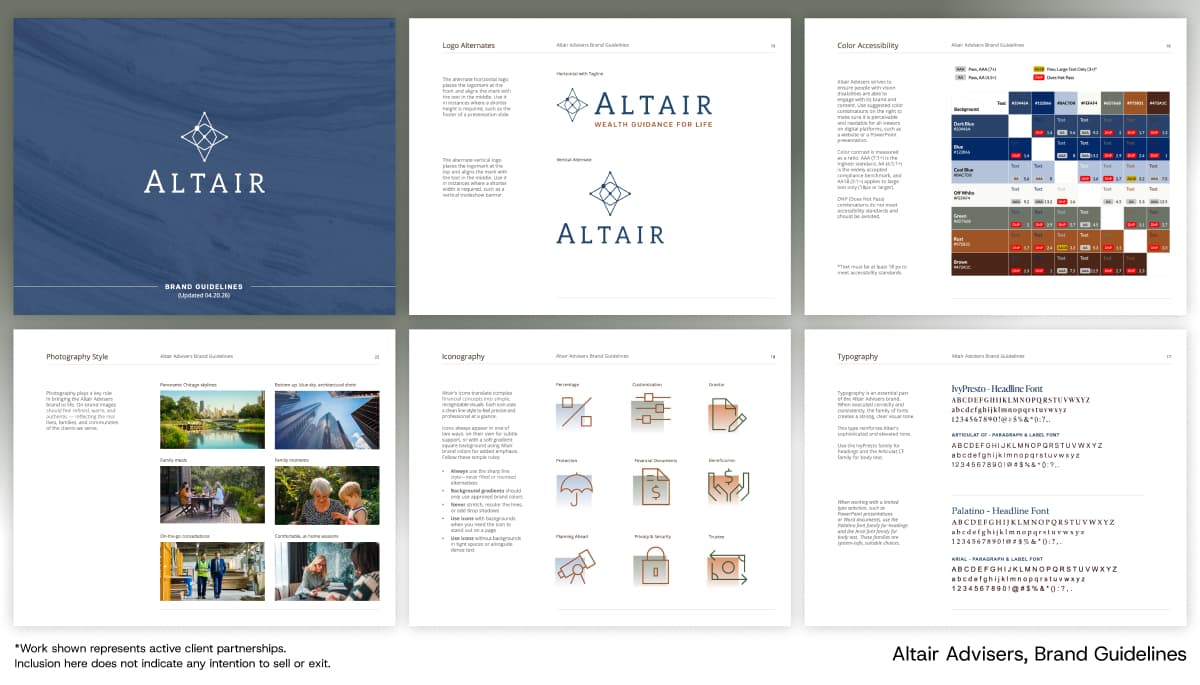
Clear brand guidelines are an underrated exit asset for a business looking to sell. They show your brand is documented, repeatable, and consistent. They also show a buyer that your brand isn’t in anyone’s head. It’s sustainable, repeatable, and transferable. From typography to tone, to color usage and messaging, guidelines take away guesswork and signal stability. This also communicates to the buyer that a sale would be smooth, as these important guidelines are already well documented and established.
Templates and Marketing Systems
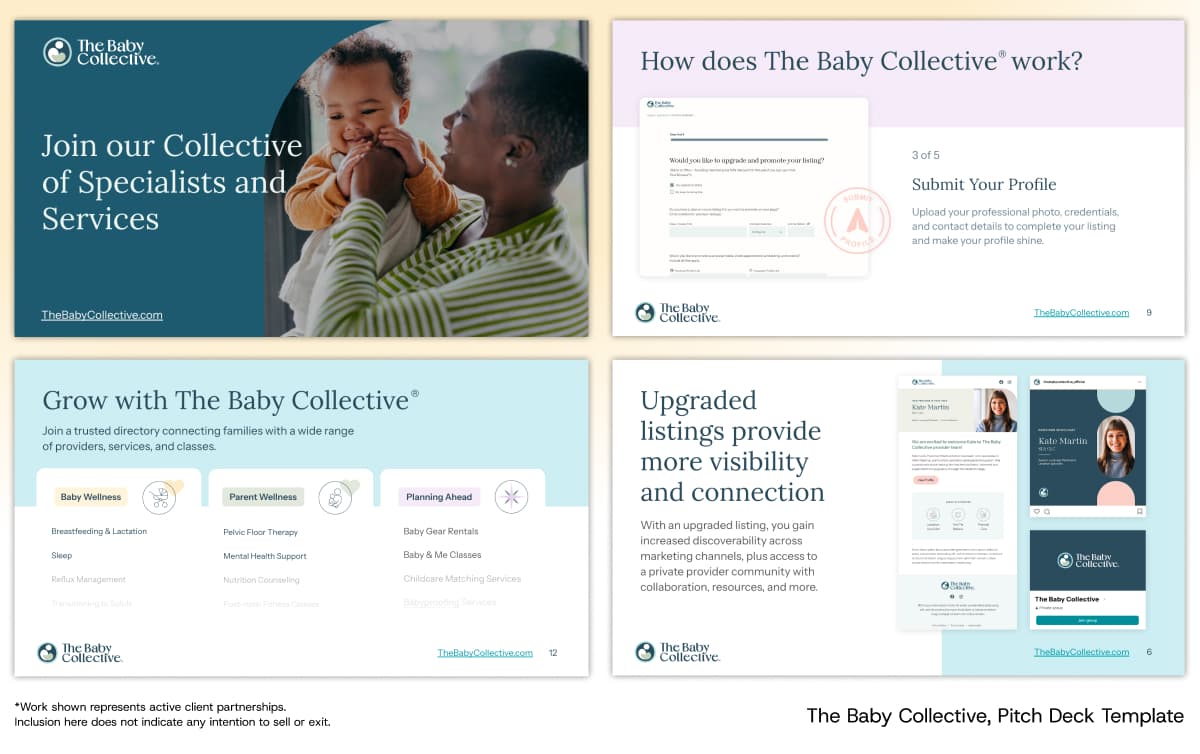
Templates and marketing systems take this a step further. Assets like sales decks, email templates, and social media calendars reduce friction and increase efficiency. They demonstrate professionalism and organization as a business and, more importantly, they’re proof that your marketing can operate without you. They ensure your brand is structured and styled specifically for each execution. Consistency across touchpoints signals a real system, not a personality-driven business. A buyer who sees the same brand voice in your deck that they saw on your website is a buyer who trusts what they’re buying. Templates are the perfect solution for this.
Your Website

Your website is doing due diligence before the buyer ever contacts you. A well-structured site that clearly communicates what you do, who you serve, and why you’re the right choice reinforces everything your financials say. An out-of-date or poorly structured website will do the opposite, and buyers notice. The domain name of your website is also important. A clean, relevant, keyword-rich domain name immediately signals legitimacy and memorability, both of which are necessary for strong brand recall and trust. Don’t underestimate the value a domain name can have. It’s very much a sellable asset in its own right. Also, do not forget to secure misspellings and alternative TLDs such as .net, .org, .co, etc.
Logo and Visual Identity

Your logo and overall visual identity are also important. Visual identity won’t single-handedly move your multiple, but it shapes first impressions and perception of quality. There’s a reason people pay more for things that look premium. A dated logo or inconsistent visual system quietly signals that the business hasn’t been invested in, which raises questions about what else hasn’t been. It’s a proven fact that customers pay more for things that look good.
Social Media
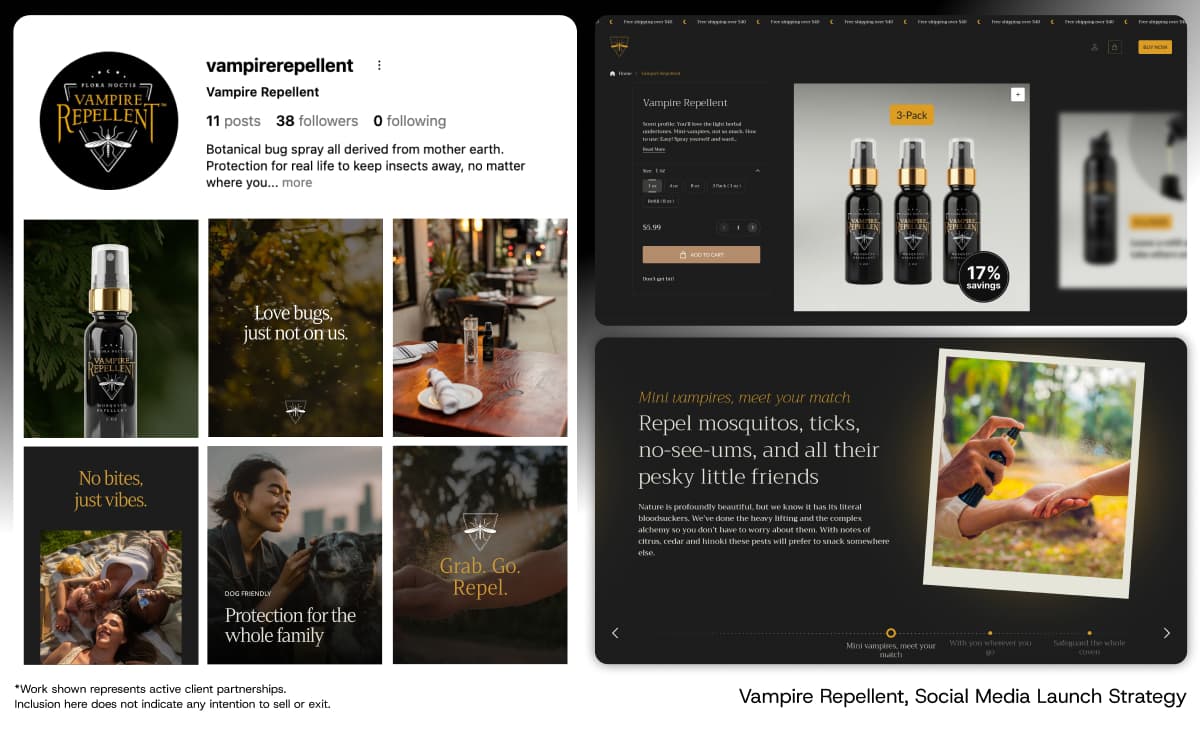
Your social media presence is one of the first places along with your website a buyer will look, and one of the easiest to evaluate at a glance. An active, consistent feed signals a business with momentum. A dormant or off-brand one signals the opposite. Buyers want to see that your brand has a pulse online, that your voice is consistent, and that someone (or a system) is showing up regularly. It also tells them that marketing doesn’t depend entirely on you. Strong social media isn’t just about followers or engagement. It’s about showing up like a brand that has its act together. If your last post was eight months ago, that’s a story, and not the one you want a buyer reading.
Think of branding a business to sell like staging a home and taking photos for the listing
When sellers prepare to list a home, they don’t just clean up and hope for the best. They paint the walls, plant flowers out front, fix the squeaky door they’ve ignored for years, maybe update the kitchen hardware or refresh the landscaping. Not because the house doesn’t function without it, but because buyers pay more for things that feel move-in ready. The outside has to match the quality inside. Your brand works the same way. A buyer walking into your business is forming an impression before they ever open a spreadsheet. When your brand looks polished and intentional, it validates your asking price. When it doesn’t, it creates doubt that even strong financials struggle to overcome.
The whole is indeed greater than the sum of its parts
Together, all of these digital business assets form a cohesive brand system. They communicate organization, consistency, and professionalism. For a buyer, they show that the business is not only capable and valuable today, but is also ready and prepared to operate successfully moving forward. That narrative is worth real money.
How your brand or business could be undervalued when you’re ready to sell
From a buyer’s perspective, an unclear or dated brand raises red flags. If a buyer (or a customer, for that matter) can’t quickly grasp what your business does, who it serves, or why it’s different, they may assume your brand lacks focus or scalability. Messaging needs to be strong, not vague; visuals need to be modern and unique, not dated; and your positioning shouldn’t blend in with the competition. By missing the mark in these areas, you risk being overlooked and undervalued, even if your business really is strong behind the scenes. Even if your operations are excellent, a weak brand creates doubt that your financials alone can’t resolve.
Think of it as the difference between information and interpretation. Your financials provide the data, but your brand provides the context. Two businesses with similar numbers can be valued differently depending on how clearly and confidently their brand communicates its position in the market. Does its design elevate the organization? Does the website strongly communicate brand messaging and values? How easily can a customer find you based on search terms or logo recognition? When your branding aligns with your performance, it reinforces credibility, leading to a higher valuation.
Another good way to think about it: your financials tell a buyer what happened. Your brand tells them what to expect. Two businesses with near-identical revenue can command very different multiples based on how clearly and confidently one brand communicates its market position versus the other. Brand alignment with performance is a credibility multiplier.
“In nearly every deal I’ve worked, the businesses that commanded the strongest multiples weren’t just the most profitable ones. They were the ones where a buyer could walk away from the first conversation with a clear picture of who the customer was, why they kept coming back, and what problem the business solved better than anyone else. Clear product-market fit, a defined customer base, and evidence that the market is pulling the product toward them rather than the owner pushing it uphill. Those fundamentals translate directly into buyer confidence, cleaner diligence, and in many cases a meaningfully higher offer. I’ve seen comparable businesses separated by a full turn of EBITDA simply because one looked like it was built to last and the other didn’t.”

Erin Guthrie, Managing Director
Another common issue is that many businesses rely heavily on the owner’s reputation rather than a strong, independent brand. Buyers aren’t just purchasing what exists today. They’re investing in what can continue on without you as the owner. If your brand can’t stand on its own without you, then it’s also at risk of being perceived for less than it’s worth.
Timing is key
If you wait until you’re actively trying to sell, it’s likely you’ve waited too long. Refining your brand and curating the above-mentioned assets takes time. Ideally, you should begin preparing 12 to 18 months before a planned exit. This allows ample time to create assets, optimize or redo your website and social media accounts, and ensure stronger market positioning.
Branding improvements compound over time. Clearer, stronger messaging attracts more customers, building lasting trust and authority. That’s a green flag to a potential buyer. Better positioning attracts better customers. Better customers produce better revenue trends. Better revenue trends produce better offers. That compounding effect is what makes early brand investment one of the highest-ROI moves you can make before a sale.
Ongoing brand improvements also save you from trying to work under pressure when a sale needs to happen quickly. Trying to overhaul a brand while simultaneously running a sale process is a recipe for a rushed job and a distracted owner. Starting early means the brand is already working for you when it matters most.
Three ways branding your business to sell pays off at exit
Every buyer is running a risk/return calculation. A well-positioned brand with clear identity and consistent execution reduces the perceived risk side of that equation—and the data on branding ROI backs this up.
Three factors drive the return:
- Increased perceived value. A business with a premium brand presence and documented systems commands better terms, even against competitors with similar revenue. It simply feels more valuable, because it is.
- A shorter sales cycle. When your brand clearly communicates what your business is and where it’s headed, a buyer doesn’t have to work to get there. That clarity converts initial interest into offers faster, with less back and forth.
- Scalability without you. Documentation, online presence, and systematized marketing all signal that the business can grow post-acquisition. That’s often the deciding factor in whether a buyer stretches their offer or holds back.
Start preparing now, not when you need to
At the end of the day, branding your business to sell is more than proving its current performance. It’s about presenting its potential and communicating its positioning with confidence and a compelling case for what it will do. When your branding is in alignment, your business is in alignment, which offers a convincing opportunity to a buyer.
Look at how your business presents itself across your website, messaging, social channels, and any other digital materials, and evaluate if it truly reflects the value you’ve worked so hard to build. Identify gaps, create assets that may be missing, and start putting systems in place to keep your brand consistent and scalable.
The earlier you start, the more these improvements compound. And when a buyer comes to the table, you want your brand to be doing the selling for you.
Branding to sell your business? Start with our brand exit-readiness audit
Before you engage anyone, run through these questions honestly. They’ll show you where your brand is working for you at the closing table and where it isn’t. A well-positioned brand answers these questions before a buyer has to ask them. That saves time, reduces friction, and justifies a higher price.
0 of 13 completed
Visibility & first impressions
Positioning & messaging
Assets & systems
Owner independence
If you're checking most of these boxes, your brand is an asset at the closing table. If you're not, or if you're unsure, that gap is worth closing before a buyer finds it for you. At Glantz, we specialize in helping established businesses get their brand exit-ready. Whether you're 18 months from a planned sale or just starting to think about it, we'll identify the gaps, build the assets, and position your brand to command the offer it deserves.
Let's talk about what your brand could be worth.