
Avoid These 10 Common Mistakes When Building a New Website

WANT TO SEE MORE LIKE THIS?
Sign up to receive an alert for our latest articles on design and stuff that makes you go "Hmmm?"
Glantz advises organizations considering a new website to avoid common pitfalls by first defining clear goals and key performance indicators (KPIs), as success is impossible without knowing the objective. It is critical to prioritize functionality over aesthetics, ensuring the website works towards its goals before focusing on its appearance. Furthermore, Glantz stresses the importance of obvious calls-to-action, a sound information architecture with a sitemap, choosing an appropriate Content Management System (CMS), and establishing a maintenance plan from the outset.
How to Avoid Common Web Development Mistakes
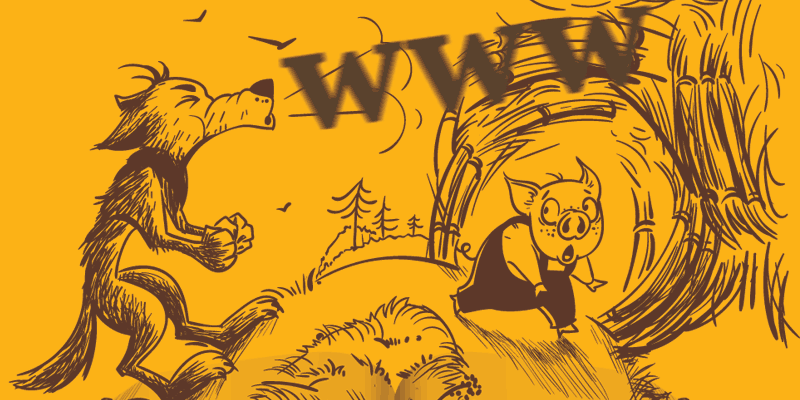
To avoid common web development mistakes, it's crucial to do things right from the start, even if it takes more effort or cost, as this leads to long-term rewards. Just like the moral of “The Three Little Pigs,” these suggestions aim to prevent you from building a “house of straw” when designing and developing your website. While these tips aren't strict rules, neglecting them could significantly derail your organization. The choice is yours: build with straw or brick?
Website Goals and KPIs
Put a post-it on your wall. What is your goal? You will never achieve it if you don’t know what it is. And conversely, your design agency most definitely won’t be successful if you aren’t able to share what that is. You’d be surprised at how many clients know they need a new website, but haven’t articulated why or what it needs to do. Define your goals and track your traffic, engagement and activity accordingly.
Function-over-Form
Too many times, designers make things look good first and then try to apply functionality. We suggest the reverse. Will your new website work toward your goals? Yes. Great, now make it look good.
Calls-to-Actions
I will assume you didn’t build a website, spend months and thousands of dollars for just fun. Your website has a purpose and I would imagine you want people to engage with your company— raise their hands of sorts. Do you want people to sign up for your newsletter, fill out a request form, buy a product, download a white paper, contact support, apply for a job, etc.? Assuming the answer is yes, do not hide calls-to-actions. Make sure the actionable items are obvious, clear, and legible. Consider adding buttons to your header or footer and make sure they are readily available.
Information Architecture
Just like the story of the Three Little Pigs you need to organize the structure of the walls. How will it be organized and built? Please don’t stress about the words and pictures until you know how the foundation will be poured. This might be the most crucial aspect of any site build. Make sure you have created a sound sitemap before proceeding to the next step.
CMS Choice
Similar to the architecture, knowing how you will be able to maintain your site before building it is mission-critical. The wolf should’ve gone after easier prey, but he literally got boiled both figuratively and physically. If you don’t have a huge internal team or have a deep knowledge of front-end-development, you should not work with a complex CMS that is difficult for you to maintain. Be realistic. Research the many platforms available today and make an informed decision.
Maintenance
Website maintenance is crucial for long-term success and security. After launching, expect to revisit your site's journey within 36-48 months, or sooner if not maintained. Most CMS-built websites require core updates, including security patches, which are mandatory. Failing to plan for maintenance from the start is a significant mistake; you must keep things up to date. Just as the little pig protected his brick house from the wolf, modern digital cybersecurity requires planning ahead to protect against threats, not just hoping for the best.
Just a quick reminder — A big, bad wolf comes and says, “Little pig, little pig, let me come in.” But the little pig says, “Not by the hair on my chinny chin chin! I will not let you in!” So the wolf says, “Then I will huff and I will puff and I will blow your house down!” The modern digital wolf might not have fangs, but cybersecurity is something you can’t just hope for the best. You must plan ahead.
Mobile First
Sure you might not think you are getting a lot of traffic from people on mobile devices. That could be the case still, but that is definitely changing. The common mistake we see is adding mobile design as an after-thought. You cannot neglect your users on the go. So when designing your responsive new website, make sure you consider mobile, tablet and desktop. Perhaps even in that order.
Search Engine Equity
If this is a site redesign you likely have already built up some search engine equity and you clearly don’t want to lose that. Your website, even if it’s terrible (being pc) still likely has some positivity with some key terms or rankings. Make sure you preserve what you earned. Even if earning just means that you lived with a terrible (again being pc) website for way too long. Make sure you have a plan in place to redirect the pages and keep the permalink structure if applicable.
Choosing Your Design & Development Team
This is not when you hire your friend’s sister’s nephew. Your website will be likely more valuable than your Director of Sales. Don’t be cheap. Hire an expert. Look at their work, get references, learn about their process and how they think they would approach a project with you.
Budget
Budget encompasses both financial resources and time, with content creation being a significant time-consuming aspect of any website. A common mistake is not allocating enough time or financial resources for writing content. Designing, developing, and maintaining a website also requires substantial investment, especially for longevity. While building a site yourself is an option, the adage "you get what you pay for" holds true. To avoid overlooked tasks, consider whether to build a temporary "straw house" or invest in professional assistance for a solid, long-term structure.
With these obvious, yet often overlooked tasks you need to ask yourself, which route you will go? Will you build a straw house on your own? Or, will you consider the longer term, take the time to do things right, and get professional assistance building a more solid structure? I’ll ask again: straw or brick?
I’m happy to provide consultation and offer friendly advice (I assure you I’m not the wolf hidden in sheep’s clothes!) to nearly just about anyone.
So, when you’re ready, let’s make awesome together.